A minister’s housing allowance is the payments made by the church to the minister for the minister’s estimated housing expenses.
The reason that most ministers will want to designate a portion of their compensation package as a housing allowance is that the housing allowance is not subject to federal income taxes. Depending upon the minister’s income tax bracket, excluding the housing allowance from the income tax calculation can result in significant tax savings.
In order to qualify for the exclusion of the housing allowance from the income tax calculation, three very important conditions must be satisfied:
- The housing allowance was approved BEFORE it was paid,
- The minister actually spent the allowance on eligible housing expenses during the year,
- Only an amount up to the fair rental value of the housing plus utilities can be excluded from income.
The church needs to play an active role in satisfying the first condition. The church should make sure the housing allowance amount is determined before it is paid (e.g. at the beginning of the employment period). There is absolutely no provision in the tax code for a retroactive housing allowance designation. It is highly recommended that the housing allowance be properly documented in the church records (e.g. annual budget, minutes, or employment contract). Frequently the housing allowance is reviewed and adjusted at the beginning of each new budget year.
The church does not have any role in satisfying the second or third conditions. The responsibility for tracking actual housing expenses and determining fair rental value of the housing rests solely upon the minister. The fair rental value of the housing can be obtained by examining comparable rent houses in the same geographical area, then adding their utility costs to that amount.
Example #1:
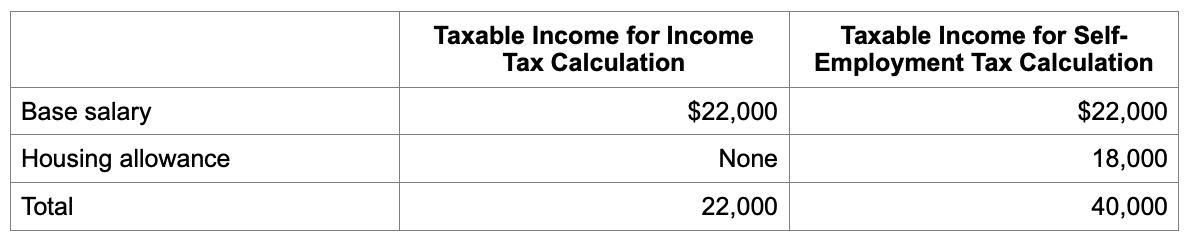
Pastor Pete is called to a new church on January 1. His total compensation package for the year is $40,000. Pastor Pete intends on continuing to live in the same house that he has lived in for several years. Pastor Pete’s mortgage payment is $1,000 per month and his other housing expenses (including utilities, insurance, property taxes, and house maintenance) average $500 per month. Based on an average of $1,500 per month, Pastor Pete expects to spend $18,000 this year on housing. Therefore, Pastor Pete could request that $18,000 of his compensation package be designated as housing allowance. Assuming the designation is made before it is paid and that he spent the entire amount on housing costs, Pastor Pete will be able to exclude the $18,000 from his calculation of income taxes. Pastor Pete’s housing allowance will still be included in his calculation of self-employment tax.
Example #2:
Pastor Pete is called to a new church on January 1. His total compensation package for the year is $40,000. Pastor Pete intends on continuing to live in the same house that he has lived in for several years. In addition to the normal $18,000 per year of housing expenses, Pastor Pete is going to spend $10,000 this year on a new swimming pool for his house. However, Pastor Pete concludes that the fair rental value of his house in only $24,000 per year ($500 utilities plus house valued at $1,500 a month x 12.) So, even though Pastor Pete is going to spend $28,000 on housing this year, he can only exclude $24,000 due to the fair rental value limitation.
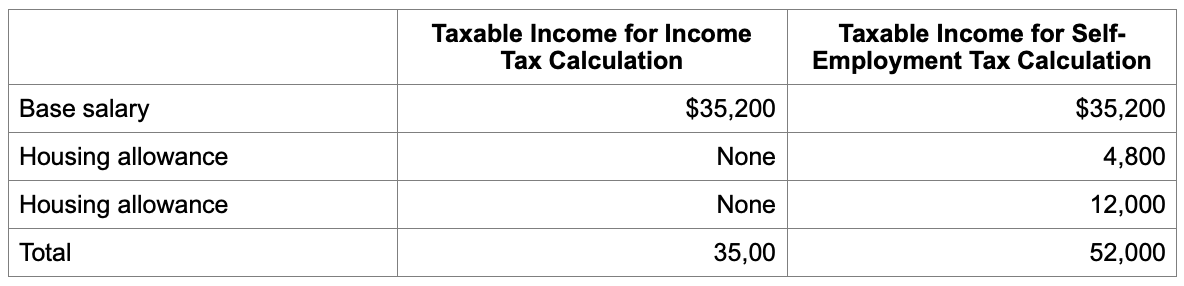
If a minister lives in the church-provided parsonage, the minister is not subject to income tax on the use of the parsonage. However, the fair rental value of the parsonage is included in the calculation of self-employment taxes.
Unless the church directly pays for all of the housing expenses, every minister should receive a housing allowance. If the minister lives in a church provided parsonage, the housing allowance can be used to pay for the expenses the church does not pay (utilities, contents insurance, furnishings, etc.). If the church provides the parsonage and pays for all associated expenses including utilities, maintenance, telephone and furnishings, there may not be a need for a housing allowance since the minister is not paying for any of these expenses from his own funds.
Assume the same facts as in the first example, except that Pastor Pete is going to move into the church parsonage. Even though Pastor Pete will be living in the church parsonage, he will be responsible for utilities and the maintenance of the house. He estimates the utilities and maintenance of the house will be $4,800 for the year. Therefore, Pastor Pete could request that $4,800 of his compensation package be designated as housing allowance. Assuming the two housing allowance conditions are met, Pastor Pete will be able to exclude the $4,800 housing allowance and the fair rental value of the parsonage from his calculation of taxable income.